
Did you know?
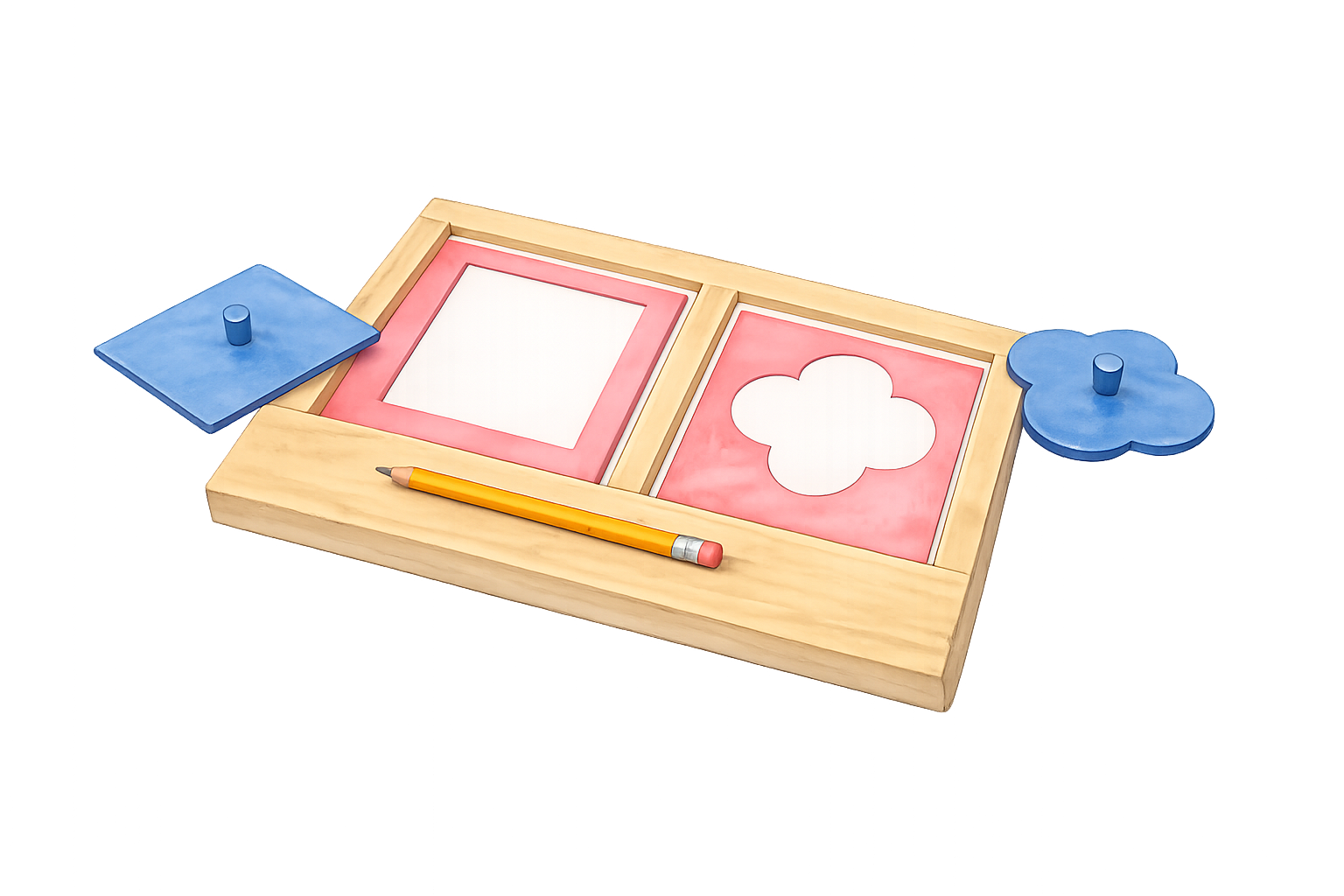
The Montessori metal insets are intentionally designed to include all the foundational shapes and pencil movements needed to write the English alphabet. Through tracing and filling in these geometric forms, children naturally practice straight lines, curves, angles, and continuous strokes that later come together to form letters.
Without writing a single letter, children are preparing their hands and brains for writing by mastering the exact movements required for handwriting. This is why metal insets are considered one of the most powerful indirect preparations for writing in the Montessori classroom.
How can families support writing at home?
Offer activities that build hand strength such as:
drawing
painting
building
working with tools
Encourage children to draw pictures and tell you about them, writing down their words when appropriate
Focus on effort and enjoyment rather than perfect letter formation
Letter reversals and uneven writing are a normal part of development.
Montessori Notes
Writing
What does “writing” mean in Montessori?
In Montessori, writing is a gradual process that begins long before a child holds a pencil. Writing development includes:
hand strength
coordination
symbol formation
the ability to express ideas
Children are prepared for writing through purposeful movement, sensory exploration, and meaningful work across the classroom.
How are children prepared for writing?
Writing readiness is supported throughout the classroom.
Practical Life activities, such as pouring, spooning, polishing, and tool use strengthen the hand and wrist
Sensorial materials refine pressure control and coordination
Art experiences like drawing, painting, and clay work encourage creativity and fine motor development
These activities build the muscles and control needed for writing without forcing pencil work too early.
What materials support writing development?
Montessori writing materials are multi-sensory and carefully sequenced.
Sandpaper letters help children learn letter shapes while hearing their sounds
Metal insets strengthen pencil grip and control through purposeful design
The moveable alphabet allows children to build words before their hand is ready to write
Children internalize sounds and shapes first, then move toward written expression.
Why does writing come before reading?
Writing is an expression of language children already know, while reading requires more abstract decoding. By allowing writing to emerge first, children experience success and confidence as communicators.
Early writing often appears phonetic, showing strong sound awareness and understanding. Conventional spelling develops later as reading skills grow.