Did you know?
Number sense is the intuitive understanding of how numbers work. It includes:
understanding quantity
recognizing patterns
estimating
comparing magnitudes
seeing relationships between numbers
Research shows that strong number sense in early childhood is one of the most powerful predictors of later success in mathematics.
Montessori materials develop number sense by allowing children to:
See that 8 is larger than 5
feel the difference between 10 and 100
build and break apart numbers physically
discover patterns independently
Rather than memorizing that 9 is bigger than 6, they know it because they have experienced it concretely.
How can families support writing at home?
Invite children into real-life math experiences:
cooking and measuring
counting objects while setting the table
sorting laundry by size
noticing patterns in nature
estimating how many steps it takes to reach a door
Use mathematical language naturally:
more than
less than
equal
half
whole
longer
shorter
Encourage problem-solving rather than giving immediate answers.
Montessori Notes
Math
What makes Montessori Math different?
Montessori Math begins with the concrete. Before children ever see abstract symbols on paper, they touch, move, build, and physically experience quantity.
In Montessori, children do not memorize math. They construct it.
Every mathematical concept is first introduced through hands-on materials that allow children to see and feel numerical relationships. Abstract symbols are introduced only after deep conceptual understanding is formed.
Why introduce math so early?
Young children have what Dr. Montessori called a mathematical mind. From birth, they are naturally drawn to order, patterns, sequencing, and classification.
Between ages 3 and 6, children are in a sensitive period for:
order
precision
repetition
pattern recognition
Cognitive science confirms that early experiences with quantity, spatial reasoning, and patterning strongly predict later mathematical achievement. Montessori environments intentionally respond to this developmental window.
How do Montessori materials build mathematical understanding?
Montessori math materials move systematically from concrete to abstract.
Children begin by physically experiencing quantity. For example:
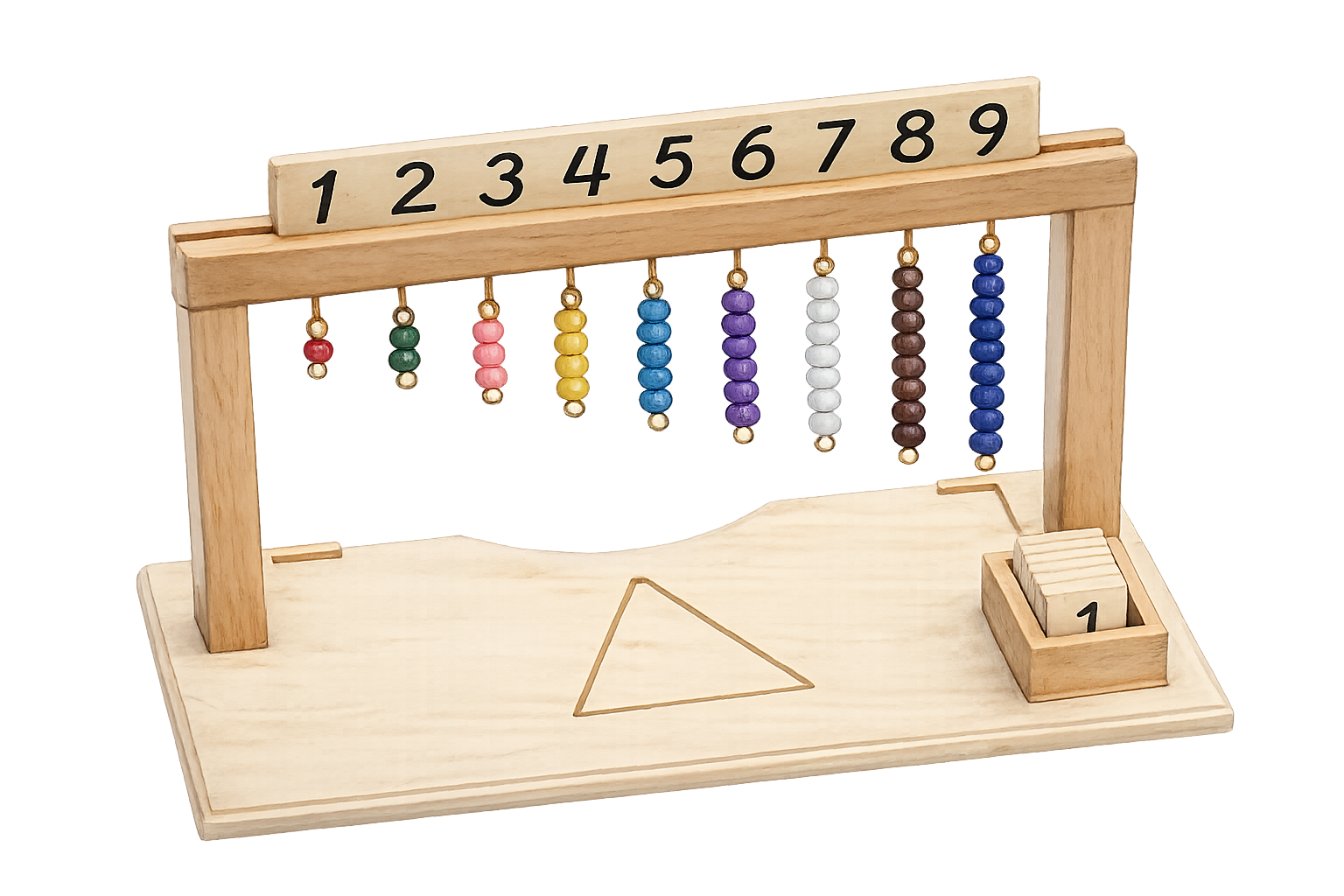
Number rods allow children to see and feel increasing length as quantity grows.
Spindle boxes connect the symbol to the exact quantity it represents.
Golden beads make the decimal system visible and tangible.
Children can hold one thousand in their hands. They can combine, exchange, and physically manipulate units, tens, hundreds, and thousands.
This physical interaction builds number sense, place value understanding, and mental flexibility long before abstract algorithms are introduced.
How does Montessori introduce the decimal system?
One of the most distinctive features of Montessori Math is the early introduction of the decimal system.
Using golden bead materials, children explore:
units as single beads
tens as bars of ten
hundreds as squares of ten bars
thousands as cubes of ten hundreds
Children learn place value through physical exchange. Ten units become one ten. Ten tens become one hundred.
This hands-on experience builds a deep understanding of regrouping, which later becomes the foundation for addition, subtraction, multiplication, and division.
How do you know when a child is ready to begin math?
In Montessori, we do not begin math based on age alone. We begin when we observe readiness.
Children often show natural signs of mathematical interest during the early childhood years. These may include:
a strong attraction to counting
noticing patterns or order
sorting and classifying objects
asking questions about quantity
repeating activities that involve sequencing
These behaviors reflect what Dr. Montessori described as the mathematical mind, a natural human tendency to seek order, precision, and pattern.
From a developmental perspective, readiness is supported by:
the ability to concentrate for sustained periods
an understanding of one-to-one correspondence
an interest in symbolic representation
growing fine motor control
Importantly, Montessori math begins with concrete quantity before abstract symbols. A child does not need to recognize written numbers to begin exploring mathematical concepts.