What is the order of learning language in Montessori?
Montessori language development follows the natural sequence of how children acquire language:
Listening
Speaking
Sound awareness
Writing
Reading
Children first build a rich spoken vocabulary and strong sound awareness before being asked to decode or read. This leads to:
Greater confidence
Stronger comprehension
A genuine love of language
How Families Can Support Language at Home
Support Spoken Language
Talk with your child, not just to them
Use real, specific words (“This is a colander,” not “that thing”)
Slow down conversations and allow time for responses
Narrate the Day with Intention
Slow down and name what’s happening throughout the day, especially during routines.
“I’m slicing the banana. The banana is soft.”
“You seem really frustrated that we need to leave the park now!”
“We’re waiting. Waiting can feel hard.”
Why this helps:
- Builds rich, descriptive vocabulary
- Connects language to real experiences
- Strengthens comprehension and emotional language
Read Together, Thoughtfully
Read aloud daily, even with toddlers
Choose books with rich language and real images
Pause to talk about pictures, predict, or wonder together
Re-read favorite books (repetition builds confidence!)
Montessori Notes
Language
What does “Language” mean in a Montessori classroom?
In Montessori, Language includes much more than learning letters and sounds. It supports the whole development of communication, including:
Spoken language (vocabulary, conversation, storytelling)
Listening and comprehension
Pre-writing skills
Phonemic awareness (hearing sounds in words)
Reading and writing, introduced gradually and joyfully
Language development begins at birth and is deeply connected to movement, sensory experiences, and social interaction.
How do children learn letters and sounds?
Children are introduced to letters through multi-sensory materials, such as:
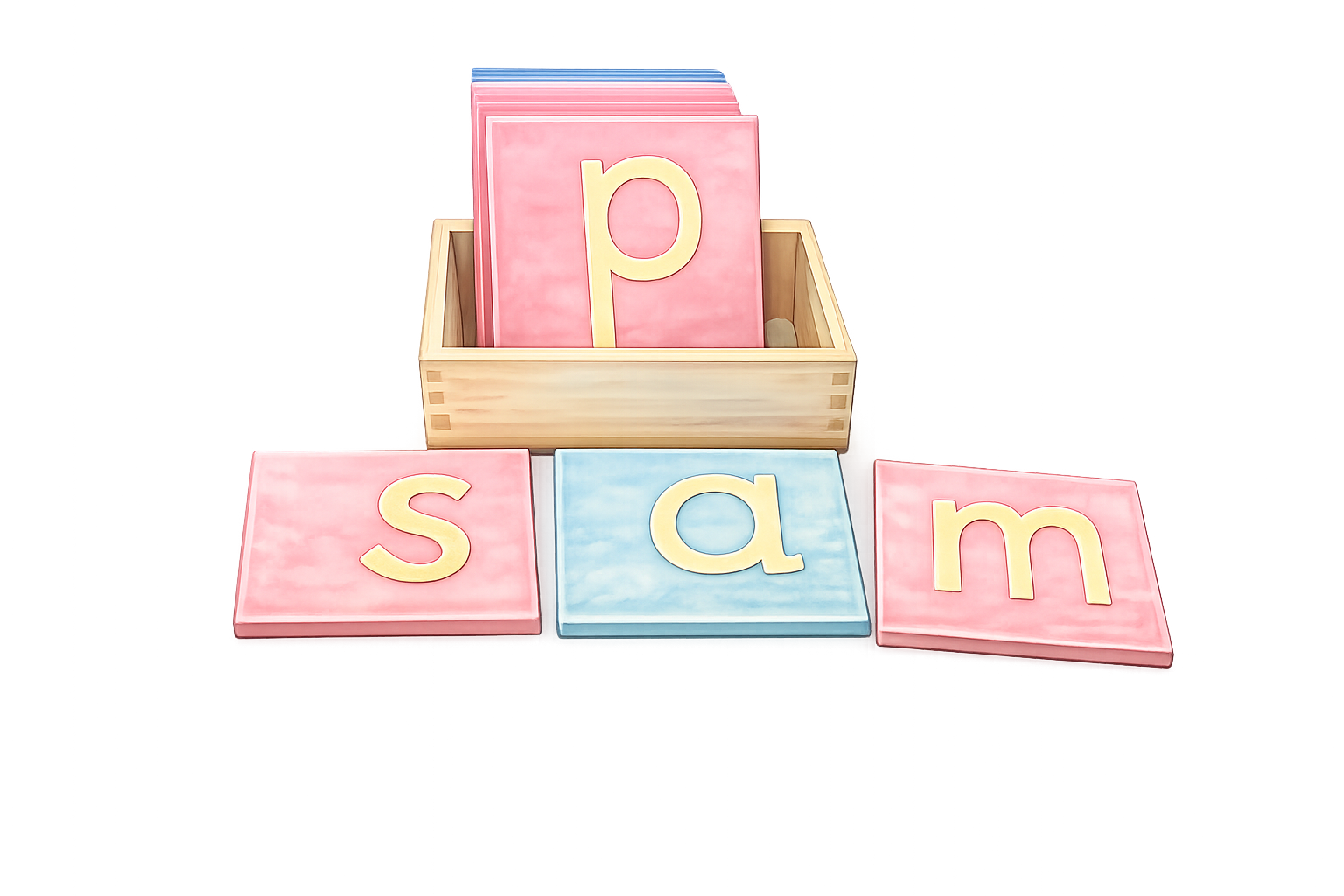
Sandpaper letters (tracing the shape while saying the sound)
Object-to-sound matching
Sound games (“What sound does sun start with?”)
This approach helps children connect:
- the sound
- the symbol
- the movement of writing
All before formal reading begins.
Why do children “write” before they read?
In Montessori, writing often comes before reading because:
Writing is an expression of language children already know
Reading requires abstract decoding, which develops later
Children can build words with materials (like the moveable alphabet) before their hand is ready to write
This sequence supports success and prevents frustration.
How Do the Montessori Language Materials Support Learning?
Montessori language materials move from concrete to abstract, helping children understand language deeply, not just memorize letters.
Object-to-object matching builds clear vocabulary using real items
Picture-to-object matching helps children understand that images represent real things
These activities strengthen comprehension before letters are introduced
Why this matters:
- Builds an accurate vocabulary
- Supports understanding
- Lays the foundation for reading with meaning
Children first learn that words describe the real world, then later connect those words to written symbols.
Why Montessori Doesn’t Teach Letters A–Z?
Montessori introduces letters by sound groups, not alphabetical order. Why?
Alphabet order is arbitrary, not phonetic
Children learn sounds more easily when they can quickly build real words
Sound boxes group letters that:
Are common in spoken language
Are easy to hear and blend
With just a few sounds, children can already read and build words like mat, sat, or cap—creating early success and confidence.
The result:
- Faster understanding of how reading works
- Less memorization, more meaning
- A joyful, empowering start to literacy