Did you know?
When children sort, match, classify, and sequence, they are strengthening essential cognitive processes:
pattern recognition
cause and effect reasoning
categorization
attention to detail
logical sequencing
Research in early childhood development shows that conceptual knowledge and vocabulary are strongly linked to later reading comprehension and academic success.
By grounding learning in real-world topics, children build background knowledge that supports future learning across all subjects.
How can families support writing at home?
Engage in real conversations about the world.
Answer questions thoughtfully and explore together.
Visit libraries, parks, museums, and nature areas.
Cook foods from different cultures.
Observe weather changes.
Talk about how things work.
Encourage curiosity rather than rushing to simple answers.
When children ask “why,” they are building the foundation for lifelong learning.
Montessori Notes
Cultural
What is the Cultural Shelf in Montessori?
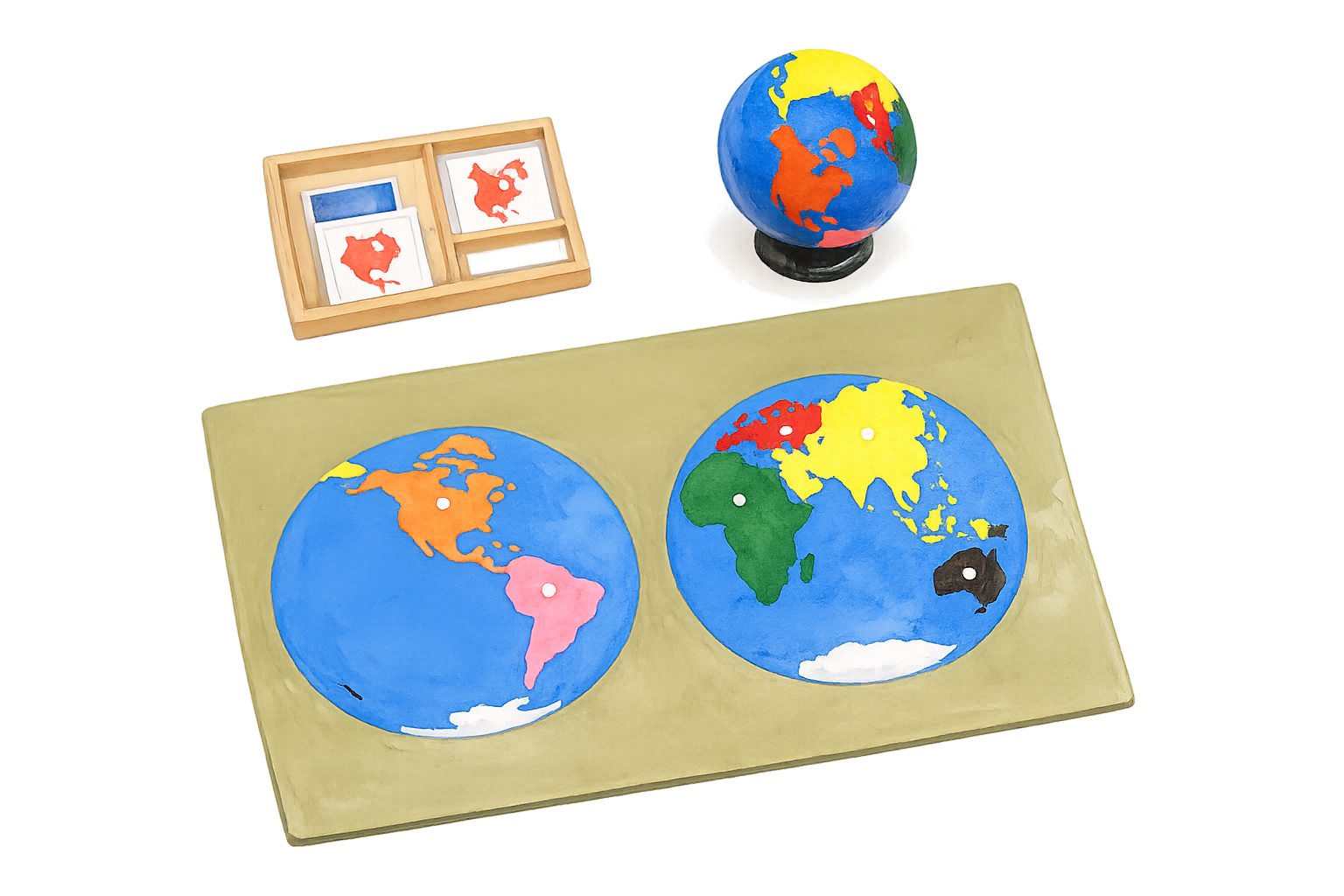
The Cultural Shelf is where children explore the wider world. It includes studies in science, geography, history, nature, and human life.
At our school, this shelf reflects the current unit of study or theme of the month. These themes grow from the children’s interests and curiosities. Examples may include:
The Human Body
Weather
The Continents
Transportation
Hibernation
Why is it called “Cultural”?
In Montessori, culture refers to everything humans have discovered, created, and learned about the world. Cultural studies help children answer big questions such as:
How does my body work?
Why does it rain?
Where do people live?
How do things move?
These studies nurture curiosity, global awareness, and respect for diversity in many forms.
How does the Cultural Shelf support language development?
The Cultural Shelf can be seen as an extension of the Language area.
Children are constantly building vocabulary and conceptual understanding. They are introduced to precise terminology connected to real knowledge.
For example:
names of continents and landforms
parts of the body
types of clouds
life cycle stages
As children manipulate materials, match cards, complete puzzles, and sequence events, they strengthen both expressive and receptive language.
How do you choose the themes?
Themes emerge from observation and conversation.
If children are deeply interested in how their bodies move or what happens at the doctor’s office, we may explore anatomy.
If we notice that they’re curious about their neighborhood and the places and spaces they live, we may move from The Continents into a more micro study of Our Neighborhood or Our City.
If we hear talks about what’s in their snacks and lunches, we might move into a Food unit.
Following children’s interests increases engagement, motivation, and retention.
What is unique about Montessori and our ability to curate our curriculum is that we have the flexibility to extend units that are deeply engaging or pivot to something different if we’re seeing less involvement in the content. This allows our teachers to respond in real-time.